

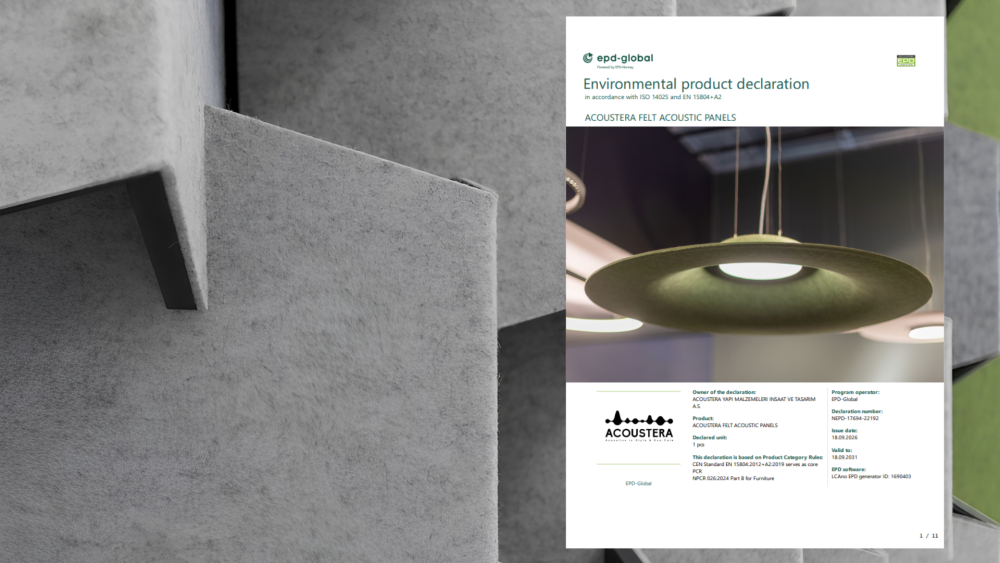
ACOUSTERA YAPI MALZEMELERI INSAAT VE TASARIM A.S. has published separate Environmental Product Declarations (EPDs) for ACOUSTERA FELT ACOUSTIC PANELS and ACOUSTERA PLUFFY FELT ACOUSTIC PANELS under the EPD-Global programme. The Felt product carries declaration number NEPD-17694-22192, while Pluffy Felt carries NEPD-17692-22195. Both EPDs were issued on 18 September 2026 and remain valid until 18 September 2031. The declarations follow ISO 14025, EN 15804:2012+A2:2019 and NPCR 026:2024 Part B for Furniture. As ERKE, we authored the Life Cycle Assessment and developed the EPD documentation for both products.
An EPD document is a standardized technical declaration that communicates a product’s environmental impacts using life cycle-based data. Standards such as ISO 14025 and EN 15804 establish the framework for reporting, methodological consistency and interpretation of environmental information. A third-party verified EPD supports transparent communication of measurable environmental performance without functioning as a rating or certification score. At ERKE, we integrate these studies into our sustainable material consultancy services.
Acoustera defines both products as modular acoustic panels manufactured from 100% polyester industrial PET felt. The panels are intended for noise management applications in offices, educational facilities and public spaces.
The reference ACOUSTERA FELT Acoustic Panel has a thickness of 12 mm, while the ACOUSTERA PLUFFY FELT Acoustic Panel has a thickness of 15 mm. Both products have an NRC value of 1.0 and are classified as B-s1, d0 for reaction to fire and Class A according to ASTM E84. The EPDs state an estimated reference service life of 15 years in accordance with NPCR 026:2024 for Furniture.
As ERKE, we structured the LCA for both products around a declared unit of 1 pcs. The system boundary follows a cradle-to-gate with options approach and includes A1-A3 product stages, A4 transport, A5 installation, C1-C4 end-of-life stages and Module D beyond the system boundary. Modules B1-B7 are not declared.
The year of study is 2026. Manufacturer-specific product composition data formed the foreground dataset, while background information incorporates registered EPDs according to EN 15804, Ostfold Research databases, ecoinvent and other LCA databases.
We developed the declarations using LCA.no EPD Generator v2025.09. The generator IDs are 1690403 for Felt and 1690405 for Pluffy Felt. Company-specific input data and the EPD were reviewed by Børge Heggen Johansen of Energiråd AS, while Elisabet Amat of GREENIZE projects is identified as the third-party verifier of the EPD tool, background data and test EPD under EPD-Global procedures.
We selected the following indicators from the complete life cycle assessment results without changing their modules or units:
| Indicator | Module / Unit | Felt | Pluffy Felt |
|---|---|---|---|
| GWP-total | A1-A3 / kg CO₂-eq | 12.64 | 10.66 |
| GWP-total | A4 / kg CO₂-eq | 1.17 | 1.04 |
| GWP-total | A5 / kg CO₂-eq | 0.97 | 1.53 |
| Net use of fresh water (FW) | A1-A3 / m³ | 1.03E-01 | 9.24E-02 |
| Total use of non-renewable primary energy (PENRT) | A1-A3 / MJ | 2.27E+02 | 1.98E+02 |
| Total energy consumption | D / MJ | -1.84 | -1.70 |
For both EPDs, the main environmental impact tables use a location-based approach for electricity-related greenhouse gas calculations. We report these figures as technical LCA results within their defined scenarios and system boundaries, rather than using them to create product rankings or environmental superiority claims.
The Felt panel contains 2.50 kg of textile felt, of which 1.50 kg, or 60.00%, is recycled content. The Pluffy Felt product contains 1.75 kg of felt, of which 1.15 kg, or 65.81%, is recycled content. The additional environmental information reports an overall share of recycled materials of 55.83% for Felt and 64.04% for Pluffy Felt.
Both declarations state that the products contain no substances included on the REACH Candidate List. VOC testing was conducted using GC-MS Headspace analysis, and the tested VOC compounds were not detected at a reporting limit of 2 mg/kg.
For the end-of-life scenario, the felt component is assumed to be 100% recycled in C3. No disposal of the felt component is considered in C4. Module D accounts for benefits associated with recycling the felt component through avoided production of equivalent virgin material.
An Environmental Product Declaration enables environmental performance to be evaluated through defined indicators rather than reducing sustainability to a single generalized claim. Reporting results together with their modules, units and scenarios gives manufacturers, designers and project teams access to traceable information for material-related decision support. Through our EPD consultancy and sustainable material consultancy services, we use this life cycle-based framework to strengthen transparency, support informed material selection and improve the reliability of environmental performance communication.
For Acoustera Felt and Pluffy Felt acoustic panels, we carried out the LCA modelling, technical data framework and EPD development process using product-specific life cycle information. Through this approach, we reported environmental impacts transparently within the framework of EN 15804 and ISO 14025. Contact us to carry out similar EPD and sustainable material consultancy processes for your projects.
“Click here to explore our EPD and sustainable material consultancy projects.”