
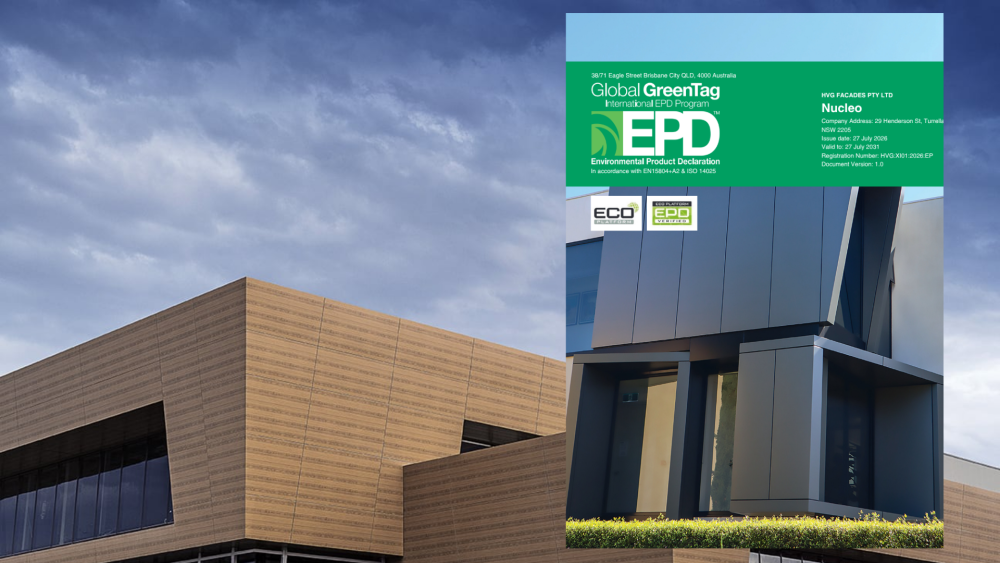
HVG Facades has published the Environmental Product Declaration (EPD) for Nucleo under the Global GreenTagCert™ EPD Program with registration number HVG:XI01:2026:EP. The declaration carries an issue date of 27 July 2026 and remains valid until 27 July 2031. The product-specific EPD follows EN 15804+A2, ISO 14025, and the Product Category Wall and Ceiling Linings Sub-PCR WCL:2023. At ERKE, we acted as the LCA and EPD Producer, carrying out the life cycle assessment modelling, structuring the technical EPD documentation, and coordinating the verification process for the Nucleo Premium Bonded Aluminium Core Panel.
An EPD document is a standardized technical declaration that communicates the environmental impacts of a product using a life cycle assessment (LCA) methodology. For construction products, frameworks such as EN 15804 structure the environmental indicators and reporting rules, while ISO 14025 defines the principles for Type III environmental declarations. A third-party verified EPD does not provide a sustainability score or rating; instead, it gives project teams transparent and structured environmental data for informed decision-making. At ERKE, we integrate EPD development into our broader Sustainable Material Consultancy services.
Nucleo® consists of two external aluminium sheets bonded to a profiled aluminium core, creating a lightweight and ultra-flat panel. The EPD defines the painted product weight as 4.482 kg/m² and the thickness as 4 mm.
The document identifies UV stability and colour retention within the intended use description. It also reports product performance results of “Deemed non-combustible” under AS 1530.1 and “Pass” under AS1530.3 and AS3837.
Within the EPD methodology, the product falls under the Wall and Ceiling Linings Sub-PCR WCL:2023. The declaration does not provide additional project-specific applications beyond the technical product description, so we do not extend the stated scope with unsupported performance or application claims.
At ERKE, we structured the life cycle assessment around the production of 1 m² of Nucleo Premium Bonded Aluminium Core Panel as the declared unit.
The EPD follows a cradle-to-gate with modules C1-C4 and module D system boundary. The declared modules are:
The EPD does not declare A4, A5 or B1-B7. The producer does not provide a reference service life.
We used a 2024 data collection period for the LCA. We modelled the assessment in SimaPro 9.5.0.0 and used Ecoinvent 3.9.1 as the background database. The electricity dataset represents the Chinese medium-voltage consumption mix, with a stated carbon footprint of 0.916 kg CO2e/kWh.
The data quality assessment covers temporal, geographical and technological representativeness, completeness, consistency, reproducibility, data sources and uncertainty. The EPD records these requirements as “Met.” We also coordinated the independent external verification carried out by Gaurav Das, supporting the publication of a third-party verified EPD.
Rather than reproducing the complete LCA results table, we highlight several indicators that provide a concise view of the declared environmental profile for 1 m² of Nucleo Premium Bonded Aluminium Core Panel:
The interpretation section identifies the A1 raw material stage as the dominant contributor. A1 accounts for 95.4% of total life cycle GWP impacts and 95.1% of total GWP-fossil impacts.
We report the negative Module D value within its defined system-boundary context. We do not subtract Module D directly from A1-A3 to create a new product-level carbon result, because the declaration reports Module D separately as potential benefits and loads beyond the system boundary.
The EPD identifies aluminium sheet, PVDF coating, polyester primer, adhesive film and protective film among the product materials. Packaging materials include a steel pallet, sulfate wrapper, timber sheet and packaging plastic.
The declaration states that the product does not contain substances included on the Candidate List of Substances of Very High Concern for Authorisation.
For secondary material use, the EPD reports SM = 0.00E+00 kg for A1-A3 and does not declare a recycled-content percentage. Biogenic carbon content equals 0 kg C/kg in the product and 0.4576 kg C/kg in accompanying packaging.
For the end-of-life scenario, the LCA assumes 50 km transportation of construction waste to the disposal site in C2. In C4, 95% of waste aluminium sheet is sent to a recycling centre and 5% is sent to landfill, while other waste such as coating goes to landfill. The C3 module reports 3.91E+00 kg of materials for recycling (MFR). For Module D, we modelled the aluminium recycling benefit according to the Circular Footprint Formula referenced in the EPD.
Third-party verified EPDs improve transparency by providing environmental information within a defined and traceable methodological structure. At ERKE, we use this approach to support designers, manufacturers and project teams in making life cycle-based decisions during sustainable material selection. Reliable LCA data, clearly defined system boundaries and standardized environmental indicators strengthen technical decision support and market confidence. Through our sustainable material consultancy and EPD consultancy services, we help transform product environmental data into information that stakeholders can evaluate consistently without turning the EPD into a rating or comparative environmental claim.
For the HVG Facades Nucleo EPD, we managed the technical process from LCA modelling and methodological structuring through EPD documentation and verification coordination. Our approach enables manufacturers to communicate product environmental performance transparently and in accordance with EN 15804 and ISO 14025. Contact us to carry out similar EPD and sustainable material consultancy processes for your projects.
“Explore our EPD and sustainable material consultancy projects by clicking here.”