

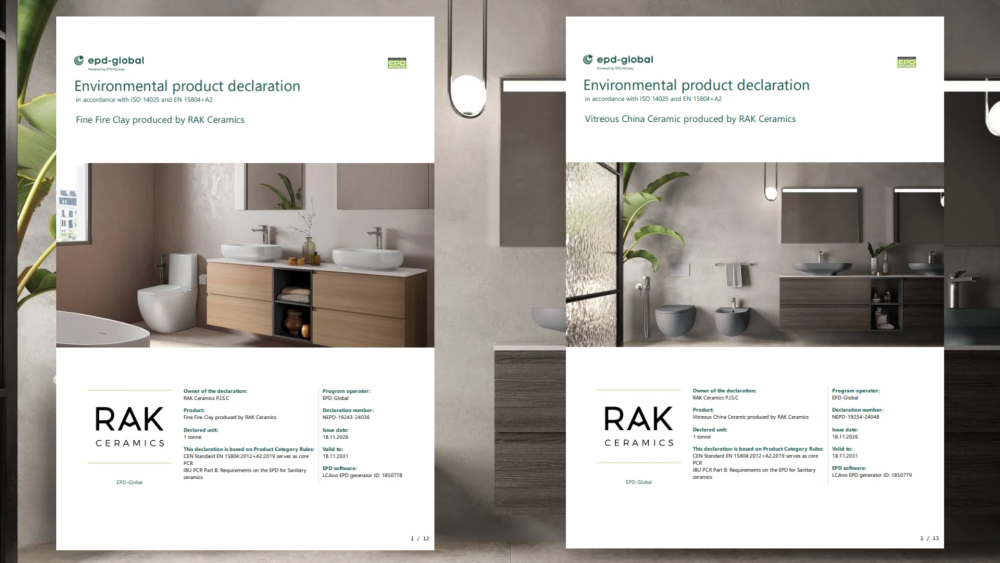
RAK Ceramics P.J.S.C. has published two Environmental Product Declarations (EPDs) for its Vitreous China Ceramic and Fine Fire Clay sanitaryware product groups. Registered under NEPD-19234-24048 and NEPD-19243-24036, these declarations were issued through the EPD-Global program on November 18, 2026, and remain valid until November 18, 2031. Both EPDs follow ISO 14025:2010, EN 15804:2012+A2:2019, and IBU PCR Part B requirements for sanitary ceramics. At ERKE, we contributed to the Life Cycle Assessment (LCA) studies and EPD development for both product groups, documenting environmental impacts from raw material extraction through end-of-life scenarios using internationally recognized methodologies.
EPD Owner: RAK Ceramics P.J.S.C.
Product Groups: Vitreous China Ceramic and Fine Fire Clay
EPD Program: EPD-Global
Program Operator: EPD-Global, Norway
Vitreous China EPD Registration: NEPD-19234-24048
Fine Fire Clay EPD Registration: NEPD-19243-24036
Issue Date: November 18, 2026
Valid Until: November 18, 2031
Standards and PCR: ISO 14025:2010, EN 15804:2012+A2:2019, IBU PCR Part B - Sanitary Ceramics
Declared Unit: 1 tonne for each product group
Manufacturing Location: RAK Ceramics P.J.S.C., Ras Al Khaimah, United Arab Emirates
Geographical Market: Global
Official Website: RAK Ceramics
Official EPD Links: https://www.epd-global.com/epder/mobel/baderomstilbehor/fine-fire-clay-produced-by-rak-ceramics & https://www.epd-global.com/epder/mobel/baderomstilbehor/vitreous-china-ceramic-produced-by-rak-ceramics
An Environmental Product Declaration (EPD) is a third-party verified technical document that communicates a product's environmental impacts throughout its life cycle. Developed in accordance with ISO 14025 and EN 15804, EPDs provide measurable environmental information based on Life Cycle Assessment (LCA). An EPD is not an environmental rating or certification of product superiority; its comparability depends on consistent methodological conditions. At ERKE, we integrate LCA and EPD development into our Sustainable Materials Consultancy services.
The Vitreous China product group includes glazed ceramic sanitaryware such as washbasins with pedestals, water closets, cisterns, bidets, and urinals.
Manufacturers produce these products from ceramic raw materials fired at high temperatures, creating a dense ceramic structure characterized by low water absorption and mechanical strength.
Their glazed surfaces provide resistance to chemicals, staining, and crazing. The products are intended for sanitary facilities in residential, commercial, institutional, and public buildings.
Fine Fire Clay consists of ceramic sanitaryware products manufactured using ceramic raw materials, including fireclay.
The material composition contributes to dimensional stability during forming, drying, and firing, making it suitable for manufacturing large ceramic sanitaryware products.
These products serve personal hygiene applications in residential, commercial, and public buildings.
The EPD includes technical test results for selected sink models assessed under BS EN 13310, confirming compliance with the specified acceptance criteria.
Both declarations use 1 tonne of finished ceramic product as the declared unit.
The system boundary covers raw material extraction, transportation, and manufacturing (A1-A3), along with transportation to the construction site (A4), installation (A5), end-of-life modules (C1-C4), and potential impacts beyond the system boundary (Module D).
Use-stage modules B1-B7 are not declared.
At ERKE, we structured the technical framework around the following parameters:
Study Year: 2025
EPD Software: LCA.no EPD Generator v2025.09
Background Databases: ecoinvent 3.10.1 and relevant LCA.no datasets
Data Quality: Manufacturer-specific product composition data supported by background LCA datasets
Allocation Methodology: Mass-based allocation in accordance with EN 15804
Third-Party Verification: Alexander Borg, Asplan Viak AS
Review of Company-Specific Data and EPD: Borge Heggen Johansen, Energirad AS
Both declarations apply the location-based approach when calculating environmental impacts associated with electricity consumption.
The EPDs provide environmental impact results for each product group based on its declared unit of 1 tonne.
The following indicators highlight key environmental and resource-related parameters.
| Environmental Indicator and Module | Vitreous China | Fine Fire Clay |
|---|---|---|
| GWP-total, A1-A3 (kg CO2-eq) | 1.25E+03 | 9.38E+02 |
| GWP-IOBC / GWP-GHG, A1-A3 (kg CO2-eq) | 1.44E+03 | 1.05E+03 |
| Fossil Resource Depletion Potential, A1-A3 (MJ) | 2.22E+04 | 1.57E+04 |
| Water Deprivation Potential, A1-A3 (m3) | 1.73E+02 | 1.11E+02 |
| Net Freshwater Use, A1-A3 (m3) | 1.11E+01 | 7.21E+00 |
| GWP-total, Module D (kg CO2-eq) | 3.79E+01 | 2.25E+01 |
Manufacturing (A3) accounts for approximately 91% of A1-A3 GWP-total for Vitreous China and 82% for Fine Fire Clay.
We report Module D separately because it represents potential environmental benefits and loads beyond the product system boundary rather than direct reductions in manufacturing impacts.
The material composition of Vitreous China includes 503.93 kg of clay and 442.95 kg of aggregate per tonne of product.
Fine Fire Clay contains 429.92 kg of clay, 341.00 kg of filler, and 167.66 kg of aggregate per tonne.
Secondary material use (SM) in modules A1-A3 is reported as 9.15E+01 kg for Vitreous China and 4.33E+01 kg for Fine Fire Clay. These figures do not directly represent recycled content percentages.
Both products report biogenic carbon content of 0.00E+00 kg C. Their accompanying packaging contains 5.30E+01 kg C and 3.10E+01 kg C, respectively.
The packaging materials consist of cardboard, plastic, and wood. Both EPDs also state that the products contain no substances listed on the REACH Candidate List.
For end-of-life modeling, both declarations assume that 100% of ceramic waste is sent to sanitary landfill.
Module D addresses potential environmental benefits and loads associated with material and energy recovery from packaging waste generated during installation.
Drawing on our engineering expertise developed since 1995, we approach environmental product assessments through transparent methodologies, reliable technical information, and structured sustainability consultancy services.
Our involvement in this project covers four key areas:
Sustainable Materials Consultancy and Preliminary Assessment: We evaluated the material compositions, manufacturing characteristics, and declaration scope of both ceramic product groups.
LCA Modeling and Technical Data Structuring: We incorporated manufacturing information into the Life Cycle Assessment framework and modeled environmental impact and resource-use indicators across the declared modules.
EPD Documentation and Verification Coordination: We developed the EPD documentation in accordance with program requirements and supported the technical documentation associated with independent review and verification.
Sustainability Communication and Product Positioning Strategy: We communicate the technical scope of the declarations clearly, supporting the presentation of RAK Ceramics' environmental product information through documented, verifiable evidence.
Life cycle-based environmental assessment supports more informed material selection decisions in the ceramic sanitaryware industry.
Through these EPDs, RAK Ceramics provides documented environmental information covering raw materials, manufacturing, transportation, installation, and end-of-life processes.
This transparency supports architects, designers, manufacturers, and procurement teams seeking reliable environmental data for material evaluation.
At ERKE, we use our EPD consultancy expertise to strengthen evidence-based sustainability communication, support responsible material selection, and contribute to market confidence through transparent environmental reporting.
Through our LCA and EPD development work for RAK Ceramics' Vitreous China and Fine Fire Clay product groups, we documented environmental impacts within an internationally recognized technical framework.
At ERKE, we combine engineering expertise with structured environmental assessment methodologies to support manufacturers in their sustainability initiatives.
Explore our EPD development and sustainable materials consultancy work by clicking here.